In the past decade, the threat of the Far-Right in the European Union has become more and more apparent, posing a challenge to the EU’s core principles of democracy, tolerance, and rule of law, and potentially destabilizing the bloc’s unity and cohesion.
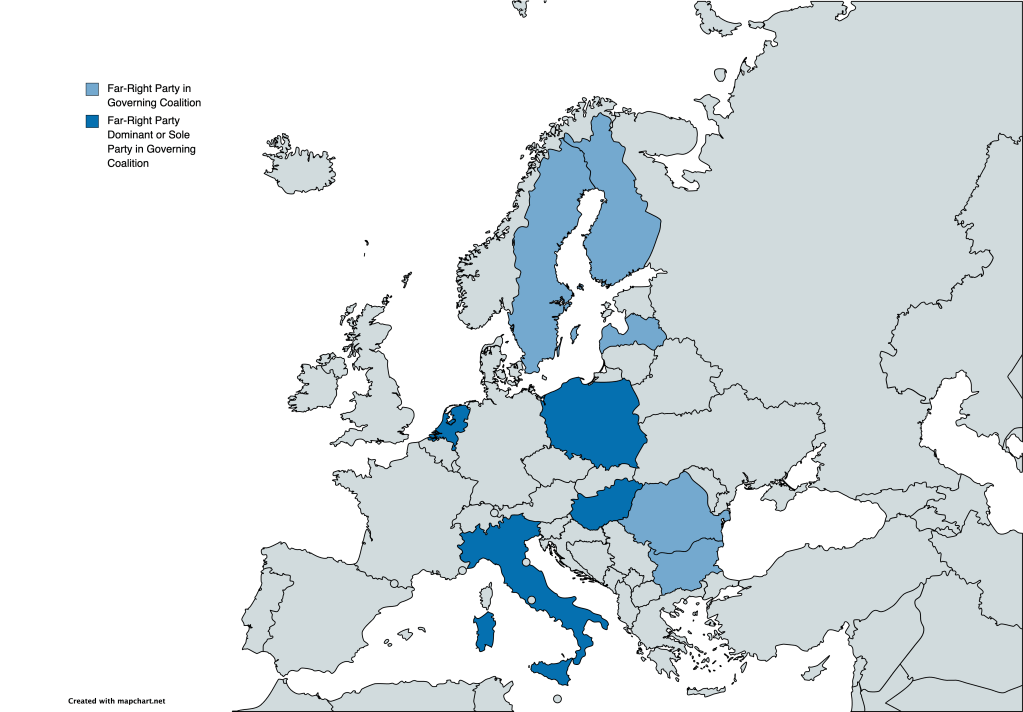
Giorgia Meloni’s Brothers of Italy (FdI), and Viktor Orban’s Fidesz party in Hungary have made sweeping changes to the social structures of their respective countries. Numerous restrictions on LGBTQ couples, restrictions on the rule of law, and new tolerance of fascism have been put in place.
In Poland, the Law and Justice (PiS) party has placed restrictions on free speech, and enacted draconian abortion laws. Its decade-long may soon be coming to an end, with an election scheduled in 2024. High inflation and the war in Ukraine have fueled discontent with the current government.
The Netherlands is seeing the opposite – with the staunchly anti-immigration Party for Freedom (PVV) recently having won election. Marked by similar concerns, Sweden and Finland have ushered in far-right parties as part of the governing coalitions. These three famously liberal and tolerant countries are facing the threat of the far right in the aftermath of the European migrant crisis.
Two Balkan states, Bulgaria and Romania, have also folded in Far right parties into their governing coalitions. With high inflation, record outward migration to Western Europe, and still out of Schengen and the Eurozone, the two nations have shifted rightward.
The European Union, unlike the rest of the Western World (the United States, Canada, the United Kingdom, Australia, Japan, etc) has seen a more significant rightward shift in recent years. Among other factors, this is perhaps a reflection of the multiparty nature of these democracies, which nations like the UK and USA lack.

 Geopolitical Maps
Leave a comment